
Macon County Supervision Types
North Carolina uses three terms that are often blended together. Probation is usually a community-based sentence imposed by a court. Post-release supervision is the supervised part of a covered Structured Sentencing felony after prison. Parole is a discretionary release framework that mainly remains relevant to older or specially governed sentences. A person can be released from a facility and still have a legal duty to report, follow conditions, or remain available to a supervising officer.
None of these labels is the same as current incarceration. A violation can lead to arrest or confinement, but an active supervision status alone does not place the person back in jail. Likewise, a prison release date followed by active supervision is not an unconditional discharge. Read both the historical custody event and the current status.
| Status | How it begins | What to verify |
|---|---|---|
| Probation | A court judgment places the person under community rules. | Judgment, current OPI status, and supervising office |
| Post-release supervision | A covered state prison term moves into its supervised phase. | Actual prison release, OPI supervision, and Commission conditions |
| Parole | The Commission authorizes release for an eligible sentence. | Sentence regime, OPI, and Commission decision status |
| Discharge | The agency records that the supervision or sentence obligation ended. | Actual discharge entry, not merely absence from a local office |
Verify Macon County Probation Records
The NC DAC offender-search gateway is the first public route because the agency says OPI includes probationers and parolees as well as state prison offenders. Search by full name or offender number. Open the correct record and compare middle name, age, sex, race, and offender number as displayed. Then read the current status separately from old incarcerations or sentence entries.
- Open the official NC DAC gateway and follow the Offender Public Information Search link.
- Use the offender number when known, or enter the narrowest reliable name criteria.
- Match the correct person with the record’s displayed identifiers.
- Read the current status and supervision details, not just a past prison release date.
- Use the live Community Supervision Directory to identify the office serving the case.
- Contact the Commission only for parole or post-release matters within its authority.
A person whose only event was a short Macon County jail stay may not have a DAC OPI entry. DAC expressly excludes county-jail history. In that situation, the court judgment and the supervising office are more useful than a state prison history search. The full Macon County released-inmate verification path also explains how the sheriff and clerk records fit.
Macon County Supervision Record Fields
OPI can include a current status, offender number, conviction county, offense and sentence history, prison admission and release events, and supervision information. Not every field appears on every person. A blank field does not prove that an event never occurred, and the same name is not enough to merge two records.
- Absconder
- A person DAC has classified as unavailable or noncompliant with supervision, not proof of a new conviction.
- Violation
- An alleged failure to follow a condition, which may lead to agency, court, or Commission action.
- Discharge
- The recorded end of the applicable supervision or sentence duty.
- Interstate compact
- The process that permits supervision to move between states without ending.
For an interstate case, the public Interstate Compact Offender Tracking search linked through DAC can help identify a transfer. A move away from Macon County does not end supervision. It may simply change the state or office responsible for it.
Macon County Absconder Status
DAC provides a public absconder search within its special OPI tools. It can test whether the agency reports an active community-supervision problem. Use the result for that limited purpose. An absconder label is not a substitute for the signed court process, a Commission action, or an authoritative warrant inquiry.
North Carolina’s NCAWARE warrant repository is not a general public name-search portal. When an outstanding process must be confirmed, contact the appropriate clerk, sheriff, or supervising office. A supervision violation can lead to different actions depending on whether the person is on probation, parole, or post-release supervision. Do not infer a new conviction from the status alone.
Important: Released from prison, active on supervision, listed as an absconder, and wanted on a warrant are four distinct findings.
Macon County Supervision Office Route
Macon County is served through a western Division of Community Supervision grouping that also includes Clay, Cherokee, Graham, Haywood, Jackson, and Swain counties. This is not a county parole board. Office assignments can change, so the live DAC Community Supervision Directory should control for the current district, location, and phone.
A caller should provide the offender number if known and ask which office supervises the case. Staff may limit person-specific details for safety, privacy, or operational reasons. The office is the practical route for a reporting location or case assignment. The Commission is the better contact for its own parole or post-release decisions and conditions.
Use the live directory for the current Macon County office assignment.
Community Supervision Directory
Note: A person’s absence from a Macon County office does not prove discharge because supervision can transfer within North Carolina or across state lines.
Macon County Parole Commission Records
The North Carolina Post-Release Supervision and Parole Commission sets post-release conditions and makes parole decisions for eligible cases. It is not the routine probation reporting office. The official Commission page states that it does not hold formal hearings and does not meet personally with offenders during parole review. Therefore, no conventional public hearing calendar should be promised for a Macon case.
Its process is administrative. The Commission has four gubernatorial appointees, and the official page says a majority must agree to approve or deny parole. The revised manual describes analyst review, voting, public input, and notice. Outcomes can include approval, denial, later reconsideration, a deferred review, conditions, rescission when authorized, or revocation after a violation. The exact decision letter or Commission response controls the wording for one case.
2020 Yonkers Road, Raleigh
4222 Mail Service Center
Raleigh, NC 27699-4222
919-716-3010
Fax: 919-716-3987
Parole.Commission@dac.nc.gov
Macon County Parole Eligibility
Structured Sentencing enacted in 1994 eliminated parole for offenses governed by Article 81B. G.S. 143B-1490 preserves Commission authority for eligible sentences while excluding those Structured Sentencing cases from parole. G.S. 15A-1371 addresses parole eligibility and consideration for covered sentence types. Offense date, sentence type, and special statutes matter.
Do not apply a generic fraction to decide that someone must be parole eligible. Life without parole and other excluded sentences do not become eligible through an estimate. For one person, identify the sentence date and legal regime in the court and OPI records, then ask the Commission for the next administrative review date and current decision status. Ask about a review date, not a hearing-room date that the Commission says does not exist.
The official Commission source shows its role and no-formal-hearing statement.
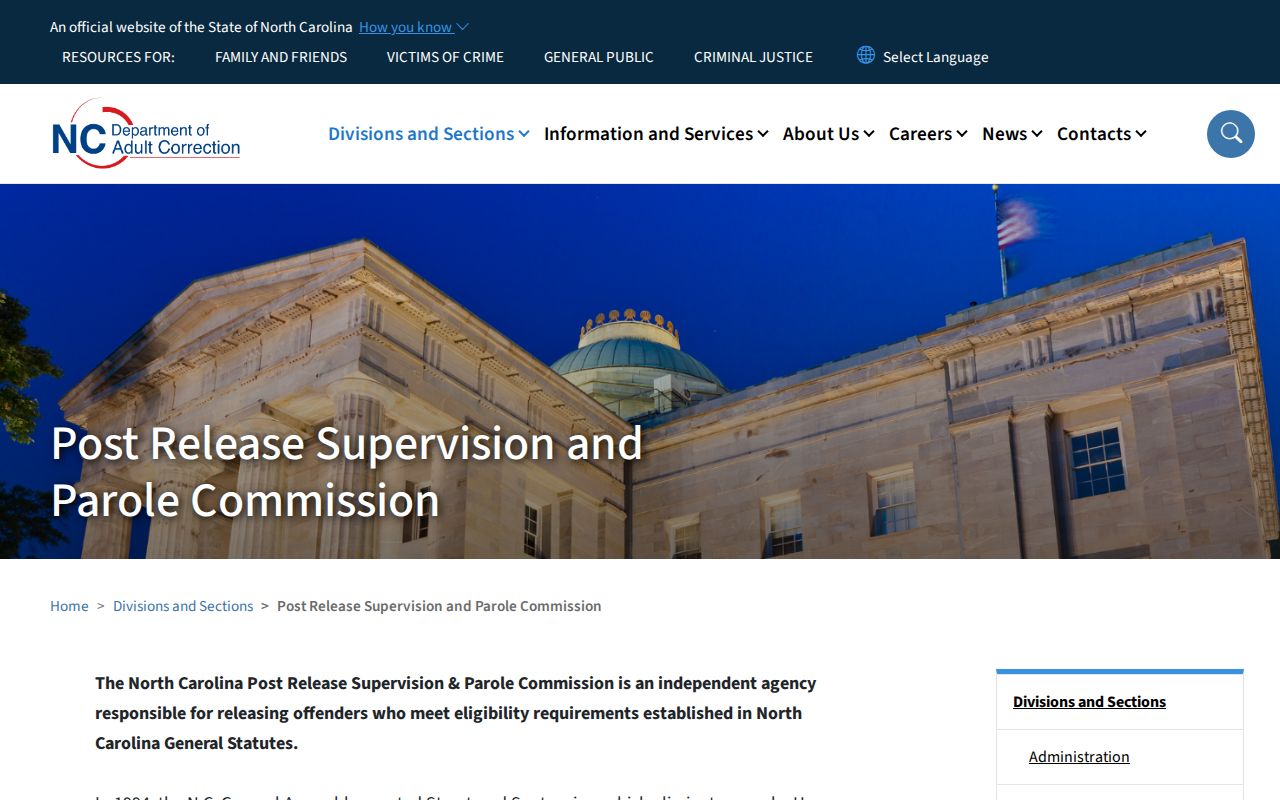
The state page separates Commission case review from the local Community Supervision reporting route.
Macon County Release Conditions
Conditions vary by legal category and case. At a high level, they can govern reporting, residence, travel, treatment, contact, financial duties, or conduct. The signed judgment, Commission document, or supervision record is the source for actual terms. A generic condition list should never be substituted for the person’s controlling order.
For probation, the court may act on an alleged violation. For parole or post-release supervision, the Commission can have a defined role. Arrest and confinement may follow in some cases, but an allegation is not a completed revocation decision. Keep the allegation, process, and outcome distinct.
Correct Macon County Supervision Data
The Macon inmate handbook provides an internal request and grievance route for someone still confined and addresses personal property. After release, a wrong jail entry should go to detention administration. A wrong public court entry should go to the Macon clerk. A wrong DAC supervision entry should be raised with DAC using the offender number, the source judgment, and the field believed to be wrong.
This division matters because no single office owns every record. The clerk cannot rewrite the DAC database, and Community Supervision does not own the sheriff’s release timestamp. Preserve a copy of the disputed screen, its search date, and the supporting order or agency record so the responsible custodian can compare the same event.
Macon County Supervision Discharge
Supervision ends when the responsible authority records discharge or another lawful termination. A person may leave prison and start post-release supervision on the same day. That actual prison release is still real, but it is not the end of the entire sentence structure. Conversely, probation can begin without any state prison admission.
Confirm the end through the current OPI status, the supervising office, and the controlling court or Commission record. NC SAVAN may provide a useful status signal, but it is designed for notice rather than a permanent certified archive. Save the agency response and its date when proof of discharge matters.
Status wording must be read literally. “Inactive” can mean that DAC no longer reports an active supervision or custody event, while a historical record remains. “Discharged” speaks to the end recorded by the responsible authority. Neither term should be replaced with a broader claim about every case, court duty, or registry requirement. When the public field is unclear, ask the office which event and legal category the date describes.