
Macon County Projected Release Dates
A projected release date is an administrative estimate for an active sentence. An actual release date records an event that has already occurred. NC DAC may display a field commonly labeled “Projected Release Date” in an active offender record. The exact live label and its status context should be preserved. An old projection should never be restated as a guaranteed exit date.
A pretrial detainee is different. Before judgment, court dates, bond conditions, holds, and case outcomes can affect custody, but there is no sentence term from which to calculate a firm release. A sentenced Macon County jail inmate may have a local calculation based on the judgment and confinement credit. A state prisoner’s public projection belongs to NC DAC, not the county jail.
Scheduled versus actual: A projected date is a forecast. A release timestamp from the responsible custodian is evidence that custody actually ended.
Find a Macon County Release Date
Classify the custody before searching. The NC DAC Offender Public Information Search is for state prison offenders, probationers, and parolees. It expressly excludes county-jail-only history. For someone serving a Macon jail sentence, ask detention administration for the local calculation and obtain the judgment and credit-for-confinement from the Macon clerk.
- Confirm whether the person is at the Macon County Detention Center or in NC DAC custody.
- For state custody, search OPI by offender number or the narrowest reliable name criteria.
- Open the correct record and read current status, sentence history, and the exact projected-date label.
- For a local sentence, obtain the signed judgment and confinement credit from the clerk.
- Ask the jail or DAC whether a detainer, later order, disciplinary change, or new sentence affects the estimate.
- Confirm departure through an actual release event rather than the projection alone.
The main Macon County release-record search explains how to request the county event and match it to the court file. Use the booking number, case number, or offender number only as needed to distinguish people.
NC DAC Macon Release Fields
The official DAC gateway says OPI accepts a name or offender ID, covers state prison offenders and people under state supervision, and includes history back to 1972. Public detail can include current status, offender number, conviction county, offense and sentence history, admission and release entries, supervision, and a projected date when applicable. Not every field appears in every record.
| Field | Use | Limit |
|---|---|---|
| Current status | Shows incarceration or supervision reported now. | Must be read apart from historical events. |
| Sentence history | Shows controlling terms and conviction facts when present. | A court judgment remains the legal source. |
| Projected release date | States the agency’s current forecast. | It can change and is not an actual event. |
| Actual release entry | Records a completed state custody change. | Supervision may continue after prison release. |
| Supervision data | Shows probation, parole, or post-release status. | It does not mean the person is still in prison. |
The official NC DAC offender search makes the name and offender-number routes visible.
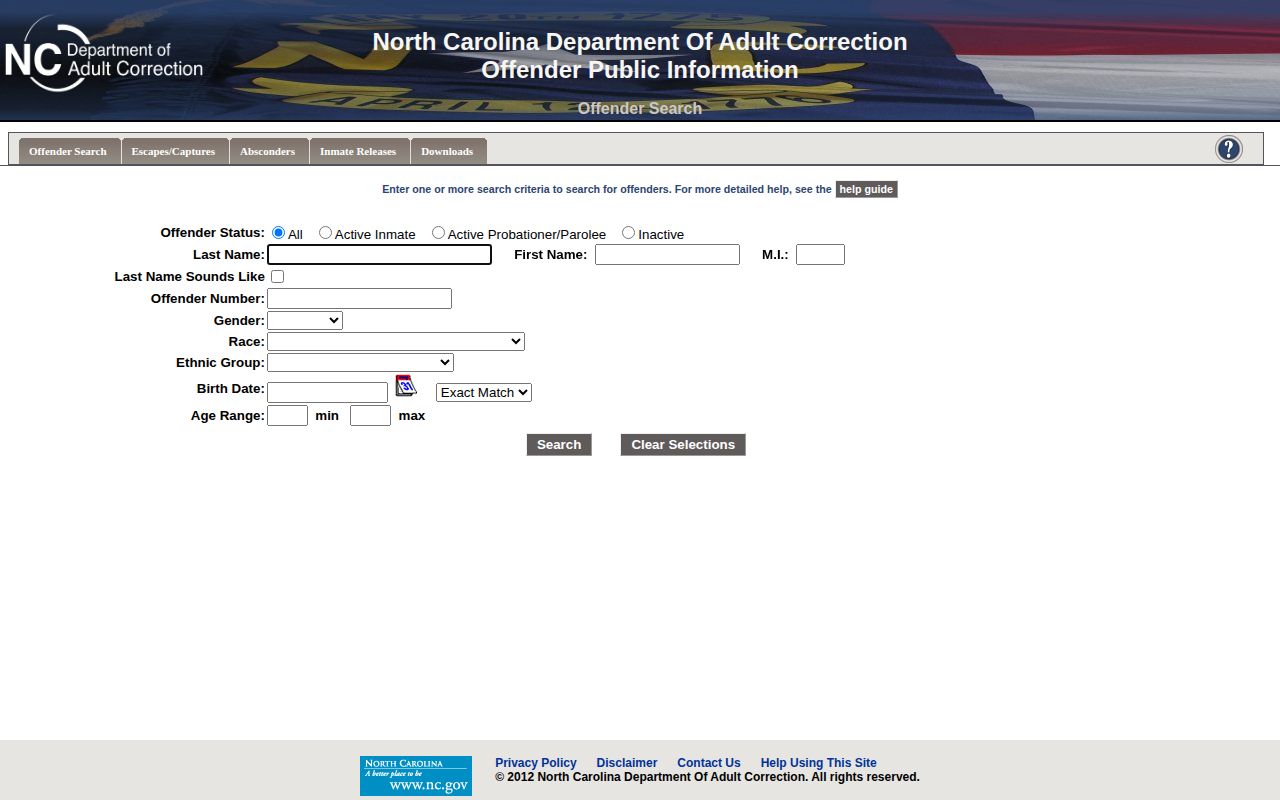
The source should be checked again when the date matters because a saved image can become stale.
Macon County Minimum Sentence Rule
North Carolina’s Structured Sentencing framework cannot be reduced to a universal claim that every person serves 85 percent. For an active felony punishment, G.S. 15A-1340.13(d) requires service of the minimum term. Earned time may reduce the maximum, but not below that minimum. G.S. 15A-1340.17 supplies maximum terms tied to the minimums and accounts for the post-release supervision framework.
The ratio between a minimum and maximum therefore varies with the statutory table and sentence. The sound general rule is simple: the court-imposed minimum is the ordinary floor, subject to specific statutory exceptions. A public projection can reflect the controlling sentence, jail credit, concurrent or consecutive structure, earned-time assumptions and awards, and later events. It should not be recreated from a percentage.
Good-time note: Earned time may reduce a maximum toward the minimum, but it does not erase the court-imposed minimum under the cited rule.
Macon County Jail Earned Time
G.S. 148-13 authorizes NC DAC rules for earning and forfeiting time and requires distribution of the regulations to local jail administrators for sentenced jail prisoners. For an active misdemeanor, G.S. 15A-1340.20(d) contains a comparable principle: the minimum must be served, and earned time can reduce the maximum no lower than the minimum.
DWI and other specially governed sentences can follow distinct rules. Do not apply a state prison projection or a standard percentage to a pretrial detainee. For a sentenced person at Macon County Detention Center, get the judgment and confinement credit, then ask the jail for its calculation under the rules that apply to that sentence.
- Minimum term
- The court-imposed floor that generally must be served for an active sentence.
- Maximum term
- The longer term that can be affected by earned-time rules within legal limits.
- Earned time
- Credit administered under correctional rules that may change the maximum-side calculation.
- Confinement credit
- Time the judgment credits toward the sentence for qualifying prior custody.
Why Macon Release Dates Change
A projected date is recalculated when the inputs change. Some changes come from sentence administration. Others come from a court or another agency. The current custodian should explain the field and the event that moved it. An online estimate without its status context is not enough.
| Factor | Possible effect | Best proof |
|---|---|---|
| Earned-time award | May reduce the maximum-side service calculation within the statutory floor. | Current DAC or jail calculation |
| Forfeiture or restoration | Can move an administrative projection. | Correctional record |
| Confinement credit | Changes the time credited to the sentence. | Judgment and sentence computation |
| Concurrent or consecutive terms | Changes how multiple judgments combine. | Signed judgments and DAC calculation |
| Resentencing or appeal | Can replace or alter the controlling sentence. | Later signed court order |
| Detainer or hold | Can prevent return to the community even when one term ends. | Sending and receiving agencies |
| New sentence | Can add a new controlling custody obligation. | New judgment and current status |
Actual release can also lead directly to supervision. Article 84A of Chapter 15A governs post-release supervision for covered sentences. Leaving prison does not mean the entire maximum sentence structure vanished, and active supervision does not mean the person remains physically incarcerated.
Macon County Weekend Release Myth
No generally applicable North Carolina statute was found that guarantees Friday release whenever a sentence would expire on Sunday. Macon County detention staff must explain how a particular signed order or expiration was processed. Do not promise an early release based on the day of the week.
Administrative steps can also occur after a judge signs an order. The court’s date and the jail’s actual exit timestamp may differ without either record being wrong. Label the order date, processing time, and physical release event separately. If a holiday or weekend is involved, ask the custodian what occurred in that specific case rather than importing a rule from another state or county.
Macon County Pretrial Release Timing
A person held before trial does not have a sentence-based projected release date. Bond can be posted, conditions can change, a charge can be dismissed, a judge can enter a release order, or another hold can keep custody in place. A calendar date shows when a hearing is scheduled. It is not a promise that release will occur on that date. The North Carolina Judicial Branch Portal can help locate the case, but the signed order and the jail event carry different proof.
For Macon County cases, obtain the conditions-of-release order, bond modification, dismissal, judgment, or other signed directive from the clerk. Then ask the detention center whether the booking ended and whether another agency received the person. The clerk generally does not maintain the precise physical exit time. Detention staff do not replace the court file as proof of why a judge acted.
A hold or detainer can also prevent a return to the community after the local legal basis changes. If the sheriff records a transfer, identify the receiving county, NC DAC, BOP, ICE, or other agency. The projected-date question then moves to the system that controls the next custody. Calling that change a community release would overstate the record.
For a historical check, preserve the court order, sheriff response, search date, and exact agency status. A no-result in OPI is expected when the person had county-jail custody only and never entered DAC custody or supervision. It does not create a release date.
Confirm Macon County Actual Release
An actual event is the final check. For Macon County jail custody, request the sheriff’s release timestamp, release code and definition, and receiving agency if any. For state prison custody, read the current OPI status and actual incarceration-history release entry. Compare either result with the signed court record when the legal basis matters.
NC SAVAN can provide a timely change signal. Search the correct agency record and register for a release or transfer notice through VINELink. Its transfer rule is crucial: a person moved to another participating agency may require a new registration under the receiving record. The detailed Macon County VINELink release check covers the reporting-agency test and PIN acknowledgement.
Do not rely on a passed projection: If the projected date is past but the current record still says incarcerated, check current DAC data and the responsible records office.
Macon County Release Date Conflicts
Dates can differ because they describe different acts. A judge can sign an order before jail staff complete release processing. DAC can record a prison departure on the same day supervision starts. SAVAN may show the event time delivered by its feed rather than the time printed on a release sheet. A BOP date can involve a transition through a reentry placement.
When records conflict, prioritize the custodian for the event. The sheriff controls the Macon booking and release event. The clerk controls filed court documents. DAC controls state custody and supervision data. BOP controls federal incarceration history. Preserve the screen date and quote short field labels so the comparison remains clear.
Do not silently choose the earliest date. Ask what each field measures and whether it is projected, ordered, processed, transferred, or completed. A later court order, restored credit, disciplinary action, or receiving-agency hold can explain a change. If OPI shows a past projection but current incarceration, the live status and DAC response outweigh the expired forecast. If the sheriff reports transfer, the next custodian must confirm what followed.
Note: An old projection is a historical forecast, while a later actual-release entry is evidence that the custody change was completed.